Rooli Casino KYC: Verification, Documents & Withdrawal Checks
 Available in US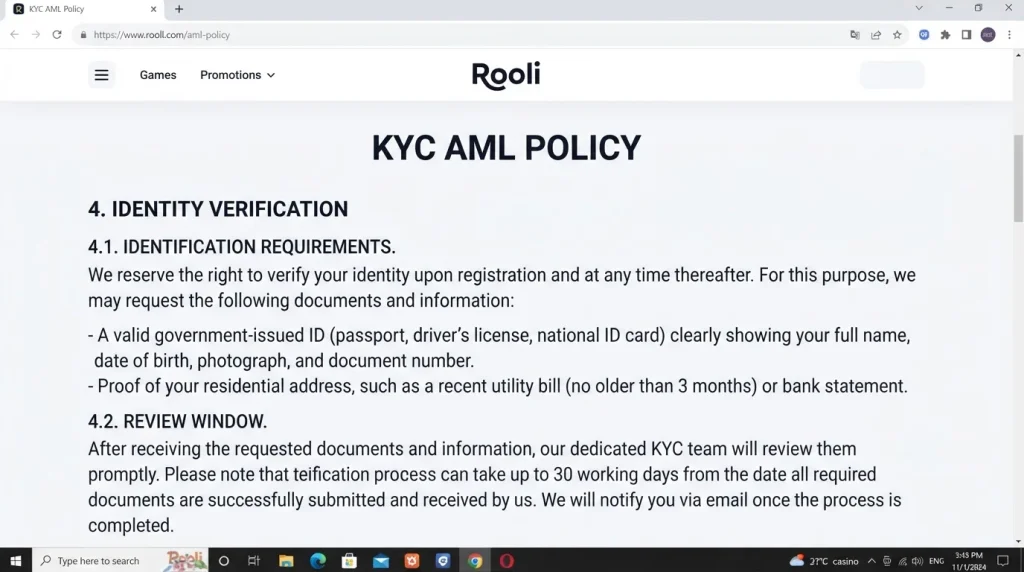
KYC guide – checked 10 September 2026
Rooli can require identity verification before an account or withdrawal is cleared. Its current KYC/AML policy names valid identification and proof of address as core evidence and allows the company to ask for additional documents or checks. The current terms also allow proof of payment method to be requested during identity checks. Most importantly for withdrawal planning, Rooli states that withdrawal requests remain pending until required verification steps are complete. The current KYC policy says consideration of KYC documents can take up to 30 working days from the point when all requested documents have been supplied. That is an outer policy window, not a promise that every review takes 30 working days and not a guarantee of faster completion. The safest preparation is to keep account details accurate, documents readable and payment ownership consistent with the name on the Rooli account.
Table of Contents
- Rooli KYC at a glance
- When can Rooli ask for verification?
- Which documents does the official policy name?
- How to prepare documents without inventing extra requirements
- The 30-working-day policy needs careful interpretation
- Why KYC can hold a withdrawal
- Payment ownership can become part of verification
- KYC and the one-account rule
- A practical Rooli verification sequence
- What KYC does not prove about Rooli
- Frequently asked questions
- Bottom line
Rooli KYC at a glance
| KYC point | Current position | Practical meaning |
|---|---|---|
| Identity evidence | Valid identification is required by the KYC policy. | Prepare a readable government-issued identity document that matches the account holder. |
| Address evidence | Proof of address is named in the KYC policy. | Use address evidence that corresponds with the residential address entered on the account. |
| Extra checks | Rooli reserves the right to request additional documentation and verification checks. | Do not assume one fixed document pair will always finish the process. |
| Payment evidence | Current terms include proof of payment method among possible identity-check documents. | Keep access to the payment account used for deposits and be ready to demonstrate ownership if requested. |
| Withdrawal status | A withdrawal can remain pending until required verification is complete. | Finish KYC before treating a cashout as approved for processing. |
| KYC consideration window | Up to 30 working days after all requested documents are supplied. | This is the published policy ceiling for consideration, not a typical-time guarantee. |
When can Rooli ask for verification?
Rooli’s current KYC/AML policy authorises identity and contact-information checks as part of account verification. The current terms connect KYC directly with the use of a Player Account and with withdrawals. That means verification is not best understood as a one-time form that always appears at the same point for every customer. The relevant question is whether Rooli has asked the account holder to complete a check and what evidence the current request specifies.
A practical consequence is that creating an account does not mean all later verification has already been satisfied. Registration data and KYC evidence are connected, but they are not identical steps. The Rooli registration covers the account information that should be entered accurately at sign-up. This page focuses on what happens when Rooli asks you to substantiate that identity or payment information.
For Australian readers, there is no advantage in trying to predict the exact moment a check will appear. Instead, prepare for the possibility that a withdrawal or account review can trigger a request. Keeping the same legal name, date of birth and residential address across the account and supporting documents reduces obvious mismatches without assuming that it guarantees approval.
Which documents does the official policy name?
The current KYC/AML policy names a copy of a valid passport or other identification paper and proof of address. The current terms give more detail on possible identity checks by referring to government-issued photo ID, proof of address and proof of payment method. Those categories are specific enough to plan around, but they should not be turned into a rigid universal checklist because Rooli also reserves the right to request additional documentation and perform additional checks.
- Government-issued identity evidence
- The current terms give passport and driver’s licence as examples of photo identification. The central requirement is that the evidence identifies the account holder and supports the age and identity information on the account.
- Proof of address
- The policy requires address evidence. Use a current document that clearly shows the same residential details used for the account, rather than assuming an old or differently formatted address will be accepted.
- Proof of payment method
- Rooli’s terms allow payment-method evidence to be requested. This fits the separate rule that deposits must come from a bank account, card, e-wallet or other payment account registered in the player’s own name.
- Additional evidence
- The operator can ask for more documentation or checks when the information already supplied is not sufficient for the verification it is carrying out.
The important distinction is between examples and guarantees. A passport and an address document may satisfy a straightforward request, but the published policy does not promise that those two items are always the complete KYC set for every account.
How to prepare documents without inventing extra requirements
A useful KYC checklist should be based on document quality and consistency, not on unsupported claims about a secret approval formula. Before uploading anything, compare the identity details in your Rooli profile with the document in front of you. Names, date of birth and residential address should be accurate. If an account detail is wrong, use the operator’s current account or support process rather than editing a document or opening another account.
Make the submitted evidence readable. Important fields should not be obscured by glare, cropping or a low-resolution capture. If proof of address is requested, check that the document actually shows the address you registered. If payment evidence is requested, use the payment method tied to your own account rather than another person’s card, bank account or wallet. Rooli’s one-personal-account rule also makes creating a second account a poor way to work around a verification problem.
Do not send extra sensitive material merely because a generic casino guide says it is commonly requested. Follow the current request shown by Rooli. A narrower approach is safer: provide the categories the operator asks for, ensure they are legible and consistent, and respond to any additional request through the official account or support channel.
The 30-working-day policy needs careful interpretation
Rooli’s current KYC/AML policy states that consideration timelines for KYC documents can be up to 30 working days from the moment the client has provided all requested documents. Two parts of that sentence matter. First, it refers to working days rather than calendar days. Second, the starting point is the submission of all requested documents, not necessarily the moment the first file is uploaded or the withdrawal is requested.
The 30-working-day figure is a published ceiling, not the normal verification time or a promise of faster completion. Some cases can finish sooner, but the current policy does not provide a universal average that would justify a shorter expectation. If Rooli asks for another document after an initial submission, the safest reading is that the account holder should complete the outstanding request before relying on the published consideration window.
Why KYC can hold a withdrawal
The withdrawal and verification stages are linked explicitly in Rooli’s current terms. A withdrawal request can remain pending until required verification steps have been completed. That makes the status of KYC more important than the moment you clicked the withdrawal button. If verification is still open, the cashout has not yet reached the same stage as an approved withdrawal being sent for payment processing.
Once a withdrawal is approved, Rooli says it aims to process withdrawal requests within 72 hours of approval. The Rooli withdrawals explains that separate post-approval timing, the current AUD minimum and rolling limits. Keeping these stages separate avoids a common mistake: counting a KYC review period as if it were part of the 72-hour operator processing target.
If a payout is delayed, the useful question is not simply “How long has the withdrawal existed?” Check whether Rooli is still waiting for identity evidence, whether all requested documents have been accepted, and whether the withdrawal itself has reached approved status. That sequence gives you a more precise basis for understanding the delay.
Payment ownership can become part of verification
Rooli’s current terms require deposits to come from a payment account registered in the player’s own name and prohibit third-party deposits. The KYC section can also request payment-method evidence. Those rules point in the same direction: the account identity and the funding identity should be consistent.
For a card or e-wallet user, the practical preparation is to retain access to the payment account used for funding and to follow the specific evidence request if one is made. For bank transfers, the same principle applies. The objective is not to collect more documents than necessary. It is to avoid a situation where the account holder cannot demonstrate that the funding method belongs to the person whose Rooli account is being verified.
KYC and the one-account rule
Rooli permits one personal Player Account per individual and applies duplicate-account controls. That matters during verification because opening a second account can create a second identity record instead of solving the first account’s KYC issue. If you cannot access an existing account or believe registration information needs correction, use the operator’s current recovery or support route rather than creating another profile.
The same principle applies to shared households or devices. The terms contain duplicate-account controls that can consider shared residential address, household, IP address or device situations. KYC should therefore be handled as a clarification process on the existing account, not as a reason to multiply accounts.
A practical Rooli verification sequence
- Read the exact request. Identify whether Rooli is asking for identity, address, payment evidence or an additional check.
- Check account consistency. Compare the legal name, date of birth and residential address on the account with the evidence you plan to submit.
- Use readable evidence. Make sure the relevant information is visible and the document is not cropped in a way that removes necessary details.
- Use your own payment evidence. If payment ownership is being checked, respond with evidence for the funding method held in your name.
- Complete the full request. The published KYC consideration window is tied to the point when all requested documents have been supplied.
- Separate KYC from payout processing. A withdrawal can remain pending during verification; the 72-hour processing target applies after approval.
- Keep the existing account. Do not create a duplicate profile to bypass a verification or access problem.
What KYC does not prove about Rooli
Identity verification is an account-control process. It is not evidence that Rooli holds an Australian gambling licence, and it should not be used as a substitute for checking the operator and regulator position. The separate Rooli licence and trust examines the current Novatrix SRL operator record, the Tobique licence and the Australian register result.
That distinction is useful because trust questions often get collapsed into one signal. A site can perform KYC because its own terms require it while having a separate licensing position in Australia. Evaluate those layers independently rather than assuming that one confirms the other.
Frequently asked questions
What documents can Rooli ask for?
Current Rooli policy and terms identify valid government-issued identity evidence, proof of address and possible payment-method evidence. Rooli can request additional documents or checks, so the exact set can depend on the verification request.
How long does Rooli KYC take?
The current KYC/AML policy says consideration of KYC documents can take up to 30 working days after all requested documents have been supplied. It does not publish a guaranteed shorter completion time.
Can I withdraw before verification is complete?
Rooli’s current terms state that withdrawal requests remain pending until required verification steps are completed.
Should I open another account if verification is stuck?
No. Rooli permits one personal Player Account per individual. Use the existing account and the current support or verification process.
Does completing KYC mean Rooli is licensed in Australia?
No. KYC and licensing are separate issues. Completing an identity check does not establish Australian regulatory approval.
Bottom line
Rooli KYC is best approached as a document-consistency and withdrawal-readiness task. The official policy names identity and address evidence, allows additional checks, and the terms can extend verification to payment ownership. The published review window is up to 30 working days after all requested documents are supplied, while withdrawals can remain pending until KYC is complete. Keep the account accurate, respond to the specific request rather than an invented universal checklist, and separate verification time from the later withdrawal-processing stage. For the broader product picture, including games, payments, bonuses and the operator context, return to the Rooli Australia review.
Recommend

Rooli Casino Pokies & Games Australia: Library, Providers & Restrictions
Rooli Australia Guide Games guide - checked 10 September 2026 Rooli has a large casino...
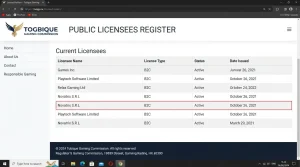
Rooli Casino Licence & Trust Australia: Tobique, ACMA & Reputation
Rooli Australia Guide Licence and trust review - checked 10 September 2026 Rooli's current terms...
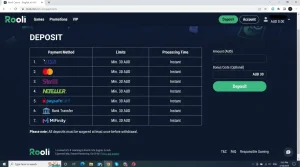
Rooli Casino Payment Methods Australia: AUD Deposits & Banking
Rooli Australia Guide Payments guide - checked 10 September 2026 Rooli accepts AUD, and its...
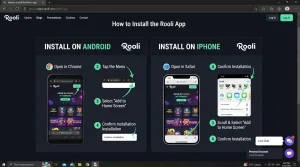
Rooli Casino App Australia: Mobile Browser & Installable Web App
Rooli Australia Guide Mobile guide - checked 10 September 2026 The verified real-money Rooli mobile...

Rooli Casino Bonus Australia: Welcome Package & Terms
Rooli Australia Guide Bonus guide - checked 10 September 2026 Rooli's current English-AU promotions page...
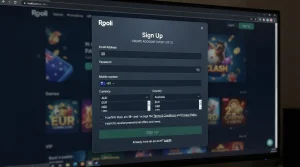
Rooli Casino Registration Australia: Sign-Up & Account Setup
Rooli Australia Guide Registration guide - checked 10 September 2026 Rooli's current terms require account...