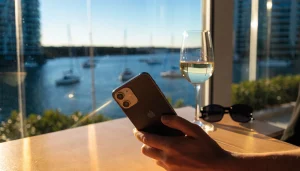
The guide explains mobile access, licensing, Australian legal context, bonus conditions and withdrawal terms to check when assessing offshore sites.

For an offshore casino, mobile access generally means opening its website in a phone browser or adding a Progressive Web App (PWA) to the home screen. These are different ways of reaching the same site, not necessarily separate services. In either case, you use the casino’s website and account rather than relying on a dedicated app downloaded from an app store.
Browser play is the default for Australian mobile users. Open the casino website in your phone’s browser, sign in with your existing account, and use the mobile version of the page. The account is typically the same one used on a desktop computer; switching devices does not, by itself, require a separate registration.
A mobile site may rearrange menus, buttons and account details to fit a smaller screen. That is a change in layout, not a different kind of account. If a page looks crowded, rotating the phone or adjusting the browser’s zoom may help, though the exact controls depend on the device and browser. You can also return to the regular desktop view if the mobile layout is difficult to use, but a desktop page may be less comfortable on a small screen.
Choosing an offshore casino as an Australian player means weighing the details that are available, such as licensing, deposit minimums and payout information. Use this list as a reference when deciding what to look into further.
Playfina Casino
Playfina Casino is listed with a Curacao eGaming licence held by Hollycorn N.V. since 2017. Its minimum deposit is A$20–30, depending on the offer.
House of Pokies
House of Pokies lists an international iGaming licence, though the source does not name the jurisdiction. PayID payouts are listed at 1–24 hours; the minimum deposit is A$30, or A$10 with PayID.
Thor Casino
Thor Casino is listed with a Curacao licence from Antillephone N.V. (Versus Odds B.V.). Its minimum deposit is EUR 20.
Golden Pokies
Golden Pokies is listed with a Curacao licence. That is the available information to consider for this entry.
MrPacho
MrPacho lists crypto payouts at 30–120 minutes and fiat payouts at 24–72 hours. Its minimum deposit is A$30.
Bizzo Casino
Bizzo Casino is listed with a Curacao Gaming Control Board licence held by TechSolutions Group N.V.
GoldenCrown
GoldenCrown is listed with Curacao Gaming Control Board licence OGL/2023/176/0095, held by Hollycorn N.V.
WinSpirit Casino
WinSpirit Casino is listed with Curacao eGaming licence OGL/2024/923/0383 from Antillephone N.V. Its minimum deposit is A$30.
SkyCrown
SkyCrown is listed with a Tobique Gaming Commission licence. Its listed payout times are around 10–15 minutes for crypto and 1–5 days for fiat; the minimum deposit is A$30.
JustCasino
JustCasino is listed with a Curacao Gaming Control Board licence. No further operator details are provided here.
Browser access avoids installing a casino-specific app. It also means you need to open the site in the browser each time, unless you save a bookmark or use a PWA shortcut. A bookmark is simply a saved link; it does not turn the website into an app or change how the account works.
Casino apps are rarely listed on Google Play or Apple’s App Store in Australia, which helps explain why browser play is common. App-store availability is not the same thing as a general catalogue of casino products: social and free-play apps that use virtual credits are available through those stores. Virtual-credit play is distinct from real-money casino play, so check what an app actually offers rather than judging by its appearance or use of casino-style graphics.
A Progressive Web App, or PWA, is a shortcut to a website that behaves more like a native app on a mobile device. It can sit on your home screen and open in an app-like window, making the casino site easier to return to without first finding the address or bookmark. The underlying service is still the website.
If a site offers a PWA, the installation prompt appears on the casino website. Tap the option to install or add it to the home screen, then confirm when your device asks. The wording and steps can vary by phone and browser. After installation, tap the new home-screen icon to open the site. Removing the shortcut later does not necessarily close or delete your casino account; it removes the way of launching the website from the home screen.
A PWA should not be confused with an app installed from an app store or with a separate program downloaded from a file. It is a website shortcut, and its features depend on the site and the device. If no installation prompt appears, the site may not offer a PWA on that browser, or the browser may provide a different route for adding a page to the home screen. You can still use the site in the browser.
Some operators may direct visitors to download an app file outside an official app store, often called sideloading. That is not the same process as installing a PWA shortcut. Sideloaded apps carry security risks, and their safety depends on the operator. A download page or an app-like icon alone does not establish that a file is safe. If you cannot establish who provides it or what permissions it requests, do not install it; browser access avoids that particular download.
Before depositing, confirm that the site accepts your location. Using a VPN to reach a casino that blocks access from your location may lead to winnings being voided or the account being closed. An offshore crypto-friendly casino is not automatically suitable just because its site opens on a phone. If an offshore casino refuses to pay winnings, there is no Australian government body to complain to on your behalf.
A page that loads poorly is not necessarily an account problem. A weak connection, limited phone memory, an outdated browser or too many apps running in the background can interfere with mobile performance. Try closing other apps, checking the connection, updating the browser or reopening the page. Avoid repeatedly submitting a form when the screen appears stuck; first check whether the previous action completed.
For a straightforward mobile setup, start in the phone browser and use the same account as on desktop. Add a PWA only if the site offers one and you want a home-screen shortcut. Treat a separately downloaded app with more caution, not less: convenience is a feature, not proof of security.
A licence is evidence that an operator says it is authorised under a particular regulatory framework. It can help you identify which authority the operator claims is responsible for overseeing it. It does not, by itself, tell you whether the site is reliable, whether every part of its business is covered, or what practical help would be available if a dispute arose.
Curaçao, the Malta Gaming Authority (MGA) and Gibraltar are among the licensing jurisdictions associated with casinos that accept Australian players. Those names are not interchangeable labels for a single standard. If a site displays one, treat it as a starting point for checking the operator’s identity and the scope of the claimed authorisation, not as a complete assessment.
Start with the licence information displayed on the site. Look for the legal name of the company said to hold the licence, the named authority and any licence reference. Then compare those details with the information available through the authority’s own channels. The name on the licence should match the company responsible for the site, rather than merely resembling a brand name or belonging to an unexplained related company.
A logo or licence badge is not the same as independently confirmed authorisation. If the site provides no clear company name or its details do not line up, you cannot reliably tell from the badge alone who is accountable. A polished presentation does not resolve that gap.
Also check what the claim actually covers. A company may operate different services or brands, so do not assume that authorisation shown for one business automatically applies to every site using a similar name. The key question is whether the specific operator and service you are looking at are within the stated licence’s scope. If you cannot establish that, the badge has limited value as evidence.
When it is genuine and relevant to the site, a licence can indicate that the operator falls under the rules and oversight associated with the named authority. That gives you a specific regulator to identify, rather than a vague promise that the site is “licensed”. It may also help you find out what complaint or dispute procedures the authority describes and which company those procedures relate to.
But a licence is not a guarantee that every transaction will go smoothly or that a particular complaint will be resolved in your favour. Nor does the word “licensed” establish how quickly a site will respond, whether it will pay a disputed amount, or what outcome an external review might reach. Those are separate questions, and a badge cannot answer them.
The important distinction is between a claim that can be checked and a conclusion that goes beyond it. Confirming that an operator is listed is not the same as proving that the service is suitable for you. Likewise, seeing a recognised jurisdiction named does not show that you have understood the terms governing an account or the route available for a complaint.
A licence from an offshore authority is not an Australian government approval. Do not read a foreign regulator’s name as evidence that an Australian authority oversees the operator or will intervene in a dispute. If an offshore casino refuses to pay winnings, there is no Australian government body to complain to for help resolving that payment dispute. That is a material limitation, not a small-print technicality.
The licence also tells you little about the quality of the site’s day-to-day communication or whether its explanations are easy to understand. Those questions require separate scrutiny. Keep a record of what the site says about its operator and oversight, and be wary of vague wording that substitutes a general claim of legitimacy for verifiable details.
A further limit is practical: a regulator’s existence does not mean that every player can obtain a remedy through it. The authority’s role, the operator’s exact identity and the procedures available all matter. If the site does not make those points clear, do not fill in the blanks based on the jurisdiction’s reputation or on claims made in promotional material.
When comparing offshore casino sites, treat licensing information as one part of due diligence. Check the named company against the authority’s records, confirm that the site itself is covered, and understand which body the operator says handles complaints. If those details cannot be matched, or the site relies on an unexplained badge, you have not established who stands behind the claim.
This is a useful test precisely because it does not promise more than it can deliver. A licence can help identify a claimed oversight relationship; it cannot certify a site as safe, settle every question about its conduct, or provide Australian government-backed recourse. The jurisdiction’s name matters, but the operator and the scope of the authorisation matter more.
A casino website that opens in one country may be unavailable in another. The operator can set its own location rules, and access can also be affected by measures taken where the visitor is connecting from. Seeing a site load while travelling, or hearing that it works for someone in the United States, does not establish that it accepts customers located in Australia.
That distinction matters before you create an account or deposit. Check the operator’s current terms for the places it accepts, and make sure they refer to your actual location. Do not rely on a site’s language, currency options or the fact that its pages are visible on your device. A website can be reachable without being available to you as a customer.
The United States is not a useful shortcut for judging access in Australia. A casino may treat visitors differently according to where they are physically located, and its rules for one country or region do not automatically apply elsewhere. Nor does a successful connection from a US address establish that the same service is accessible from an Australian one. The relevant question is whether the operator accepts customers at your present location, not whether the site has a general international presence.
There are several different things people may mean when they say a casino is “accessible”: its homepage opens, its games appear, registration is available, or the operator will let someone deposit and later request a withdrawal. Those are not interchangeable. A page may display while account creation is restricted; a user may be able to start signing up but then be stopped during verification. A site’s terms and its response to your location are more meaningful than a page loading successfully.
For Australian visitors, access can also be interrupted by blocking. The Australian Communications and Media Authority, or ACMA, takes steps to prevent people from reaching gambling sites that operate illegally. As a result, a failed connection may reflect a block rather than a problem with your phone or internet service. Repeatedly trying different routes to reach the same site does not resolve the underlying question of whether the operator accepts your location.
If you are physically in Australia, treat an access block as a reason to stop and check the position, not as a technical puzzle to work around. Offshore crypto-friendly casinos are not made suitable for Australians simply because they advertise international access or accept cryptocurrency. A payment option says nothing by itself about whether the site accepts people in your location.
A virtual private network, or VPN, routes your internet connection through another location. That can make a site see an address that does not match where you are physically present. It does not change your actual location, and it does not make an operator’s location rules disappear.
Using a VPN to reach a casino that blocks access from Australia can breach the operator’s terms or cause the information on your account to appear inconsistent. The operator may close the account or void winnings if it decides that access rules were evaded. Even if a VPN lets a page open, it cannot guarantee that you will be allowed to register, keep an account open or withdraw funds. The risk is not limited to the moment you sign in; location checks may take place later.
Do not enter false location details or rely on someone else’s address to get around a restriction. If an operator does not accept your actual location, the practical answer is not to disguise it. Before depositing, confirm directly in the terms or with the operator that customers where you are physically located are accepted. If that cannot be established clearly, do not proceed.
A site that was reachable earlier may later become unavailable. Access can differ between networks or change when blocking measures are applied. That does not prove that a casino has changed its location policy, and a temporary connection problem does not prove the opposite. Avoid treating either a working page or an error message as a complete account of the operator’s rules.
Keep the distinction clear: technical access is not permission, and a claim of acceptance is not a guarantee of a successful withdrawal. If an offshore casino refuses to pay winnings, there is no Australian government body for you to take that complaint to. That is a material consequence to weigh before sending money, not a detail to investigate only after a dispute begins.
“Offshore” describes an operator’s relationship to the country where a customer is located. In casino discussions, it generally means the operator is based or licensed outside that customer’s country. It is a geographical label, not a quality mark: it does not, by itself, tell you whether a site is trustworthy, suitable for you or able to serve people where you live.
The label can also blur two different things. An operator may be headquartered in one place and hold a gambling licence issued by another. Common licensing jurisdictions associated with casinos that accept Australian players include Curaçao, the Malta Gaming Authority and Gibraltar. Those names identify places or authorities connected with licensing; seeing one on a site does not, by itself, explain the operator’s full business arrangements or establish that the site is a good choice.
That distinction matters because “offshore” is often used as if it were a practical guarantee. It is not. The word tells you something about location, but not whether a particular site’s claims are accurate, how it handles customer disputes or whether its conditions suit your needs. Likewise, calling a site the “best” offshore casino does not make the description meaningful without evidence and clear criteria. A label is easy to print; substantiating it takes more.
Any casinos presented as recommendations on this page are offshore and crypto-friendly. That description is not an endorsement, and neither characteristic establishes that a casino is safe or suitable for you. Crypto-friendly means that cryptocurrency is among the payment options the operator may support; it should not be taken to mean that every transaction is available to every customer, or that withdrawals will be straightforward. The site’s own rules and the terms applying to your account still matter.
Casinos that accept Australian players are often associated with licensing from Curaçao, the Malta Gaming Authority (MGA), and Gibraltar.
Nor does an offshore address settle whether you can use a site from your location. Before depositing, confirm directly with the operator that it accepts customers where you are. Do not treat a page loading on your phone as proof that your location is accepted. If access is blocked, using a VPN to get around the restriction can put your account at risk: the operator may void winnings or close the account. A workaround is not a reliable substitute for permission.
The same caution applies to complaints. If an offshore casino refuses to pay winnings, there is no Australian government body for you to complain to about that operator. That makes it important to understand who you would need to contact and what process the site says applies if a dispute arises. The word “offshore” does not tell you whether that process will be useful, fair or easy to pursue.
A more precise way to read the term is as a starting point for questions, not an answer. Where is the operator based? Which jurisdiction is named in its licensing information? Does the site clearly identify the company behind the service? Do its rules explain how it handles accounts and disputes? Those questions concern the site in front of you; the broad label cannot answer them on its own.
“Offshore” may describe where a casino operates from or where its licence comes from. It does not certify its conduct, guarantee access from Australia or establish that its terms are acceptable. Treat it as a description of location, then assess the specific claims and conditions separately.
Australian law draws a distinction between the conduct of an online casino operator and that of an individual who accesses an offshore service. The Interactive Gambling Act 2001 prohibits operators from offering online casino-style games to people in Australia. The restriction covers services such as online poker and casino games, including blackjack, roulette and pokies. It is directed at the provider, rather than making the act of playing at an offshore mobile casino an offence for an individual under that Act.
That distinction can be easy to miss when a site is available to visit. An operator’s ability to present a website, accept account registrations or display games does not mean it is permitted to provide those services to people in Australia. Nor does the fact that an individual player is not made criminally liable under the Act make the operator’s service lawful here. The law addresses those two sides differently.
The minimum age is a separate requirement: you must be at least 18 to register and gamble in Australia. Meeting that age threshold does not alter the restriction on operators offering online casino-style games to people located in the country. It is a condition for an individual’s participation, not permission for a provider to supply a prohibited service.
Enforcement can also affect what you can reach. The Australian Communications and Media Authority (ACMA), the national communications regulator, works to prevent access to gambling sites that are operating illegally by blocking them. A block is an enforcement measure directed at the site; it does not change the underlying distinction between operator restrictions and individual-player liability. It also means that a page being reachable at one point is not reliable evidence that the service is authorised to operate in Australia.
If you are trying to understand whether an offshore casino is legal, be precise about what you mean. The answer differs depending on whether you are asking about an operator offering casino-style games to people in Australia or an individual choosing to play. Under the Interactive Gambling Act 2001, the operator is prohibited from offering those games here, while playing at an offshore mobile casino is not illegal for an individual under that Act. This is a limited statement about that law, not a declaration that every aspect of a particular service or transaction is lawful.
There is a practical consequence beyond access: if an offshore casino refuses to pay winnings, there is no Australian government body for you to complain to about that refusal. That leaves you without a domestic government complaints route for resolving a payment dispute with such an operator. The difference between operator prohibition and individual liability should therefore not be mistaken for government approval or protection.
These points describe the Australian legal position, not an endorsement of offshore services. They are also not a substitute for advice about a specific situation; laws and enforcement can change, and the details of an individual case may matter.
Before treating an offshore crypto-friendly casino as a possible option, confirm that its terms explicitly accept people located in Australia. Do this before depositing, and do not use a VPN to get around a block: the operator may close the account or void winnings if it detects access from a restricted location. These checks do not change the Australian restrictions on operators offering online casino games.
Read the identity-verification rules alongside the withdrawal terms. A first withdrawal commonly triggers KYC, or “know your customer” checks: you may be asked for identification, a selfie and proof of address. Find out which documents are accepted, how they must be submitted and whether verification must be completed before a withdrawal can be approved. If the process is unclear, treat that as a reason to pause rather than assume you can resolve it later.
Check whether withdrawals are capped by day, week or month, and whether the cap applies to your account, payment method or a particular type of winnings. A specialist review has reported weekly limits in the $4,000–$10,000 range at some casinos; that is an attributed report, not a reliable expectation for every site. The relevant limit is the one in the operator’s current terms, so look for the exact rule and how it affects larger balances.
Also look for rules on pending withdrawals, account reviews and what happens if requested documents are rejected. Keep a copy of the terms you relied on. If an offshore casino refuses to pay, there is no Australian government body to complain to about recovering those winnings. That leaves you with limited practical recourse, so unclear verification or withdrawal rules deserve serious weight in your decision.
A ranking is a set of claims, not proof that an offshore crypto-friendly casino is safe or suitable for you. Treat labels such as “top” as a prompt to check the details behind each entry, not as an endorsement. A polished page can still omit conditions that matter when you try to deposit or withdraw.
Start with payment rules. Check whether each method is available to Australian customers, whether it can be used for withdrawals or only deposits, and whether withdrawals must go back through the method used to deposit. A specialist review reports that some casinos apply those restrictions, but rules can differ between operators and change. Confirm the current terms on the casino’s own site before sending money.
Card acceptance is not assured either. A specialist review notes that some Australian banks may block or flag gambling-related card charges, causing a deposit to fail. A failed transaction does not establish that the casino has rejected you, so check with your bank before trying another route. Do not treat a ranking’s payment badge as confirmation that a particular method will work for your account.
Before depositing, confirm directly that the site accepts your location. Using a VPN to reach a blocked casino may breach its terms and can lead to winnings being voided or your account being closed. If an offshore casino refuses to pay, there is no Australian government body to complain to about recovering those winnings.
If you consider a bonus, read its terms before claiming it: check wagering requirements, eligible games, expiry dates and cashout caps. A ranking cannot tell you whether those conditions fit your circumstances. The same is true of claims about support, payments or withdrawals: look for clear, current terms rather than relying on a badge or a brief verdict.
A directory can show payment logos without answering the useful question: can you deposit and withdraw by the method you intend to use? For any offshore crypto-friendly casino you are assessing, compare the payment rules on its own site rather than treating a list as confirmation.
Check each method twice: once in the deposit section and again in the withdrawal rules. E-wallets such as MiFinity, Skrill and Neteller are used for both transactions, but availability at a particular casino still needs checking. A payment option shown for deposits does not, by itself, establish that it can be used to cash out.
PayID is described as near-instant for deposits and typically free in a specialist review, but those details should not be treated as a standing guarantee. Check the operator’s current terms and any fees before making a decision. For every method, look for the stated processing stages and whether the casino’s own handling time is separate from the provider’s. If the terms do not explain this clearly, that uncertainty matters.
Record what each candidate says about deposits, withdrawals, fees and processing, then compare like with like. Do not assume that a familiar payment name means the transaction will work with your bank or account. Confirm that the site accepts your location before depositing. Using a VPN to reach a blocked casino may lead to winnings being voided or the account closed.
There is also a limit to what a payment comparison can protect you from: if an offshore casino refuses to pay, there is no Australian government body for you to complain to. A shortlist is a way to check conditions, not a guarantee of access or payment.
A bonus headline does not tell you what you must do before any associated winnings can be withdrawn. The terms matter more than the label, including when an offer is described as a no-deposit bonus. “No deposit” refers to how the offer is presented; it does not, by itself, tell you whether winnings are withdrawable or what conditions apply.
Wagering requirements specify how much qualifying play is required before a bonus can be cleared. A specialist review describes welcome-bonus requirements in the range of 30x to 50x the bonus amount, but that should not be treated as a rule for every offer. Read the specific terms and check what amount the multiplier applies to. A large requirement can make an offer difficult to use, even if the advertised bonus looks generous.
The minimum deposit and the time allowed to meet the requirement also affect the calculation. Check whether a deposit is needed at all, what counts as eligible wagering and when the offer expires. If you cannot meet the conditions within the stated period, the bonus may not provide practical value.
Read the game restrictions before claiming. The terms should make clear which games count towards wagering and whether some are excluded or contribute differently. Also check for a cashout cap: it may limit the amount that can be withdrawn from bonus-related winnings. Do not assume the cap applies only to the bonus itself; confirm exactly what the wording covers.
Compare the conditions as a package rather than judging an offer by its headline. If the requirement, eligible games, expiry date or withdrawal cap is unclear, ask the operator to explain it in writing before you opt in. Once accepted, the terms may determine what you can withdraw.
Cryptocurrency can make a withdrawal quicker, but a short processing estimate does not tell you when funds will reach your wallet. Specialist casino reviews report that crypto and e-wallet withdrawals may be processed in under 24 hours. Treat that as a reported estimate, not a promise: the casino’s own review and approval process can affect timing, and its current terms should explain what happens after you request a payout.
Before depositing, check whether the chosen currency can be used for both deposits and withdrawals. Some casinos restrict particular methods to deposits or require withdrawals to use the same method as the deposit. Read the withdrawal rules for any minimum or maximum transaction amounts, fees, pending periods and identity checks. The first withdrawal may require identity verification, such as identification, a selfie or proof of address, so find out what documents are requested and when.
Crypto also adds a step that card or bank payments do not: you need to use the correct wallet address and supported currency. A transfer sent to the wrong address may not be recoverable. Check the casino’s instructions carefully and make sure you understand any network requirements before confirming a transaction.
Speed is only one consideration. Look for account controls such as deposit, loss and wager limits, session time limits and self-exclusion, and understand how to activate them. Confirm that the site accepts your location before depositing. Using a VPN to reach a blocked casino may lead to winnings being voided or the account being closed. If an offshore casino refuses to pay, there is no Australian government body to complain to on your behalf. A quick withdrawal estimate cannot make those risks disappear.
Yes, you can use social or free-play casino apps with virtual credits. They are different from real-money casino games.
No. You can open the casino website in your phone’s browser and use your existing account.
No. Australian players typically use a mobile browser or, if offered, add the site as a PWA shortcut.
A mobile browser casino is the website opened in your phone’s browser. A native app is a separate app installed on your device; a PWA is a home-screen shortcut to the website, not a separate program.
It is a casino website saved to your home screen so it opens in an app-like window. The casino service and account remain on the website.
Only if its terms suit you: check the wagering requirement, minimum deposit and deadline before accepting. Requirements are commonly 30x–50x the bonus, and many offers must be cleared within 7–10 days.