Rooli Casino Payment Methods Australia: AUD Deposits & Banking
 Available in US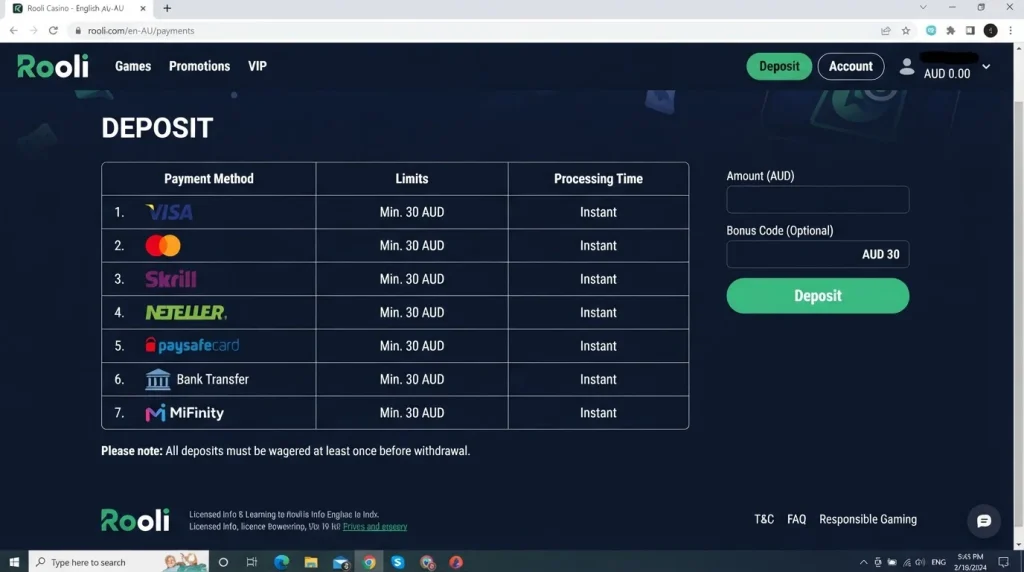
Payments guide – checked 10 September 2026
Rooli accepts AUD, and its current English-AU payments page lists deposit options including Visa, Mastercard, Skrill, Neteller, Paysafecard, Bank Transfer and MiFinity. Rooli’s current terms set the minimum deposit at 30 AUD, subject to the payment method chosen. The public AU payments page currently shows $30 for those listed fiat deposit entries, but the live cashier remains the better account-level check because method visibility and limits can change. PayID is widely used in Australia, but current Rooli-specific evidence does not establish it as a cashier method, so it should not be presented as supported. General Australian payment popularity and Rooli-specific support are separate questions.
Table of Contents
- Rooli payment methods confirmed for Australian-facing users
- AUD support matters more than a generic dollar sign
- What the 30 AUD minimum actually tells you
- Cards are common in Australia, but popularity is not support
- PayID: popular in Australia, not verified here as a Rooli method
- E-wallets and bank transfer: compare the live route
- Crypto is supported, but it is a separate banking decision
- Account-name matching and payment verification
- A practical Rooli cashier checklist
- Deposit methods do not answer withdrawal questions
- Payment support does not establish local licensing
- Bottom line on Rooli payment methods in Australia
Rooli payment methods confirmed for Australian-facing users
The current English-AU payments page is the useful starting point, not a generic list of methods popular in Australia. On 10 September 2026, the AU route visibly included the following deposit methods. The page also shows additional rails, but a long public table should not be treated as proof that every listed option is available to every individual account.
| Method | Type | Current public AU deposit entry | What to confirm in cashier |
|---|---|---|---|
| Visa | Card | $30 minimum shown | Card eligibility, live minimum, issuer approval |
| Mastercard | Card | $30 minimum shown | Card eligibility, live minimum, issuer approval |
| Skrill | E-wallet | $30 minimum shown | Wallet visibility, account-name match, current limits |
| Neteller | E-wallet | $30 minimum shown | Wallet visibility, account-name match, current limits |
| Paysafecard | E-wallet / prepaid | $30 minimum shown | Whether the option is active for the account |
| Bank Transfer | Online bank transfer | $30 minimum shown for deposits | Live route, bank support and any account-level instructions |
| MiFinity | E-wallet | $30 minimum shown | Wallet availability and current transaction limits |
Rooli’s terms independently support the AUD minimum: they state a 30 AUD minimum deposit and note that the precise maximum varies by payment method and is shown when the option is selected. That is why this guide does not invent a universal maximum deposit. The payment-method screen at the point of use is the authoritative place to check a live maximum.
AUD support matters more than a generic dollar sign
Rooli’s terms explicitly include AUD among accepted fiat currencies. That matters because an Australian reader should not have to infer whether a dollar-denominated public page means AUD, USD or another currency. The official terms resolve the base-currency question directly: AUD is accepted, and the current minimum deposit is listed as 30 AUD.
Currency support does not mean every payment rail will behave identically. A card, e-wallet and bank transfer can have different issuer checks, account-level availability or maximums. The practical comparison should therefore start with the method visible in your cashier and then ask whether the live transaction currency is AUD, what minimum and maximum are shown, and whether your payment provider will add any separate charges.
What the 30 AUD minimum actually tells you
The current Terms and Conditions state that the minimum deposit is 30 AUD, with the amount dependent on the chosen payment method. The public AU payments page also currently shows $30 across the main fiat deposit entries listed above. Together, those sources make 30 AUD a useful baseline for the current Australian-facing payment journey.
It is still a floor, not a promise that every method will always accept exactly the same amount. Payment providers can have their own transaction rules, and Rooli states that maximum deposits vary by method. Before depositing, select the actual method in the cashier and read the amount fields shown there. That avoids a common error where a review copies one minimum or maximum across cards, wallets and bank transfer without checking whether the operator applies method-specific rules.
The same principle applies when a promotion is involved. A casino’s ordinary payment minimum and a promotion’s qualifying deposit can be related but are not automatically the same rule. Use the Rooli bonus guide for promotional qualification rather than assuming that a valid cashier deposit always triggers a bonus.
Cards are common in Australia, but popularity is not support
Reserve Bank of Australia research for 2025 found that cards remained the dominant payment method for Australian consumers, accounting for about 73% of payments, with debit cards making up about half of transactions. That broader context helps explain why card support is a useful feature to verify, but it cannot establish what a casino accepts. Rooli support must come from Rooli-specific evidence.
For Rooli, the current AU-facing payment evidence includes Visa and Mastercard. The operator’s public payment table currently labels those deposit entries with a $30 minimum. Before using a card, confirm that the card option is visible after sign-in and that the card belongs to you. Rooli’s terms state that deposits must come from a payment account registered in the player’s own name and prohibit third-party deposits.
A card can also be declined by an issuer or payment institution even when it is shown by the merchant. Rooli’s terms state that deposits must be successfully processed and confirmed by the relevant payment institution before the funds appear in the casino account. For that reason, an option being listed on the site is not the same as a guarantee that a particular card transaction will succeed.
PayID: popular in Australia, not verified here as a Rooli method
PayID deserves explicit treatment because it is a familiar Australian payment rail and is prominent in casino-related search results. RBA research found that around 80% of respondents were aware of PayID in 2025 and around half reported using it during the prior year. That is strong evidence of general Australian adoption, but it is not evidence that Rooli supports PayID.
Current Rooli-specific evidence does not establish PayID as a cashier method. The accurate conclusion is therefore neither “Rooli accepts PayID” nor “Rooli never accepts PayID”. It is narrower: PayID is not currently confirmed as a supported Rooli method. If it later appears in the live cashier, that operator-specific information should take priority over assumptions based on Australian popularity.
This distinction is the main value of an AU-specific banking guide. A list headed “best Australian payment methods” can easily mix national payment habits with methods actually offered by one casino. Those are different questions and should remain separate.
E-wallets and bank transfer: compare the live route
Skrill, Neteller and MiFinity are part of the verified AU-facing Rooli method set, and Paysafecard plus bank transfer are also shown on the current English-AU payment route. E-wallets can be useful for users who prefer not to enter card details for each transaction, while bank transfer can suit users who prefer a bank-based route. Those are general workflow differences, not promises about speed, fees or withdrawal eligibility.
The current public Rooli payment page labels many deposit entries as free and instant, including the core fiat methods listed here. That is the current public-page presentation, not a universal guarantee about every stage of a transaction. Your bank, card issuer or wallet can have separate rules, and a payment can still require institutional confirmation before it reaches the Rooli balance. Check the live cashier and your payment provider rather than treating one public label as the full cost and timing picture.
Bank transfer deserves extra attention because deposit and withdrawal conditions can differ. This parent page intentionally does not turn withdrawal timings or limits into deposit claims. For cashout mechanics, use the dedicated Rooli withdrawals guide.
Crypto is supported, but it is a separate banking decision
Rooli supports multiple cryptocurrencies, including BTC, BCH, ETH, DOGE, LTC and USDT, and the terms list additional crypto currencies. That establishes crypto support, but it does not mean cryptocurrency is a mainstream Australian payment preference. The RBA’s 2025 consumer research found that only about 2% of respondents reported using cryptocurrency to make a payment in the prior year.
For a Rooli user, the practical questions are more specific than whether crypto exists: which coin is visible in the cashier, what network is required, what live minimum is displayed, and whether the selected currency matches the intended transaction. Rooli’s terms state that crypto transactions use real-time exchange rates and that currency exchanges between crypto and fiat are not supported. Because crypto has its own deposit mechanics and promotions, the detailed coin discussion belongs in the Rooli crypto payments guide.
Account-name matching and payment verification
Rooli’s current terms require deposits to come from a bank account, card, e-wallet or other payment account registered in the player’s own name. Third-party deposits are prohibited. That makes name consistency an important preparation check before funding the account. A mismatch between casino registration details and the payment owner can create a preventable verification problem.
The terms also reserve the right to verify identity before processing withdrawals. An exact document checklist is not repeated here because payment setup and KYC are separate topics, but the dependency matters: a deposit route should be chosen with later verification in mind. Keep ownership records and transaction information consistent, and do not assume that a successfully funded account means no verification can occur at cashout.
If you have not opened an account yet, the Rooli registration guide covers the sign-up flow and the account details that should be kept consistent with later payment information.
A practical Rooli cashier checklist
- Confirm AUD. Check that your selected account and transaction route are using AUD where expected.
- Use a method actually shown in the cashier. Do not rely on a generic Australian payment-method list.
- Check the live minimum. Current terms set a 30 AUD minimum deposit, subject to the method chosen.
- Check the maximum on the selected method. Rooli states that maximum deposits vary by method rather than publishing one universal figure.
- Use a payment account in your own name. The terms prohibit third-party deposits.
- Separate deposit and withdrawal assumptions. A deposit method, speed or limit does not automatically predict the corresponding cashout route.
- Do not infer PayID support. PayID is common in Australia but is not currently verified as a Rooli method.
- Check provider-side costs. A casino fee label does not tell you whether your bank, card issuer, wallet or network will charge separately.
The current public payment table can be checked on Rooli’s English-AU Payments page, while the minimum deposit and own-name funding rule are stated in the current English-AU Terms and Conditions.
Deposit methods do not answer withdrawal questions
A banking review becomes confusing when deposit methods, withdrawal routes, processing targets and withdrawal limits are all collapsed into one table. Rooli’s own public payments page presents both sides of the cashier, but the decision questions are different. A deposit question is mainly about getting funds into the account using a supported rail and currency. A withdrawal question adds approval, identity checks, method-specific cashout rules and operator processing.
For that reason, exact withdrawal minimums, limits and timing are kept on the dedicated withdrawal guide, where the high-risk figures can be checked against current official terms. AUD deposits and method verification remain the focus here.
Payment support does not establish local licensing
Seeing AUD and Australian-facing payment options can make a site feel local, but currency and payment support are not evidence that an operator holds an Australian gambling licence. Those facts must be checked independently. This site therefore does not use an AUD cashier, a familiar card logo or an Australian-language route as a substitute for regulatory verification.
For operator identity, offshore licence information and Australian regulatory context, use the separate Rooli licence and trust page. Keeping payment convenience separate from licensing produces a clearer assessment of what the cashier does and what it does not prove.
Bottom line on Rooli payment methods in Australia
Rooli accepts AUD and its current English-AU payment evidence includes Visa, Mastercard, Skrill, Neteller, Paysafecard, Bank Transfer and MiFinity. Current terms set the minimum deposit at 30 AUD, subject to method, and require deposits to come from a payment account in the player’s own name. Australian payment popularity should not be used to fill gaps: PayID is widely known and used nationally, but current Rooli-specific evidence does not verify it as a cashier option. Use the live cashier to confirm method visibility, the current minimum and maximum, and any provider-specific conditions before depositing. For the overall brand assessment, return to the Rooli Australia review.